Nebulae
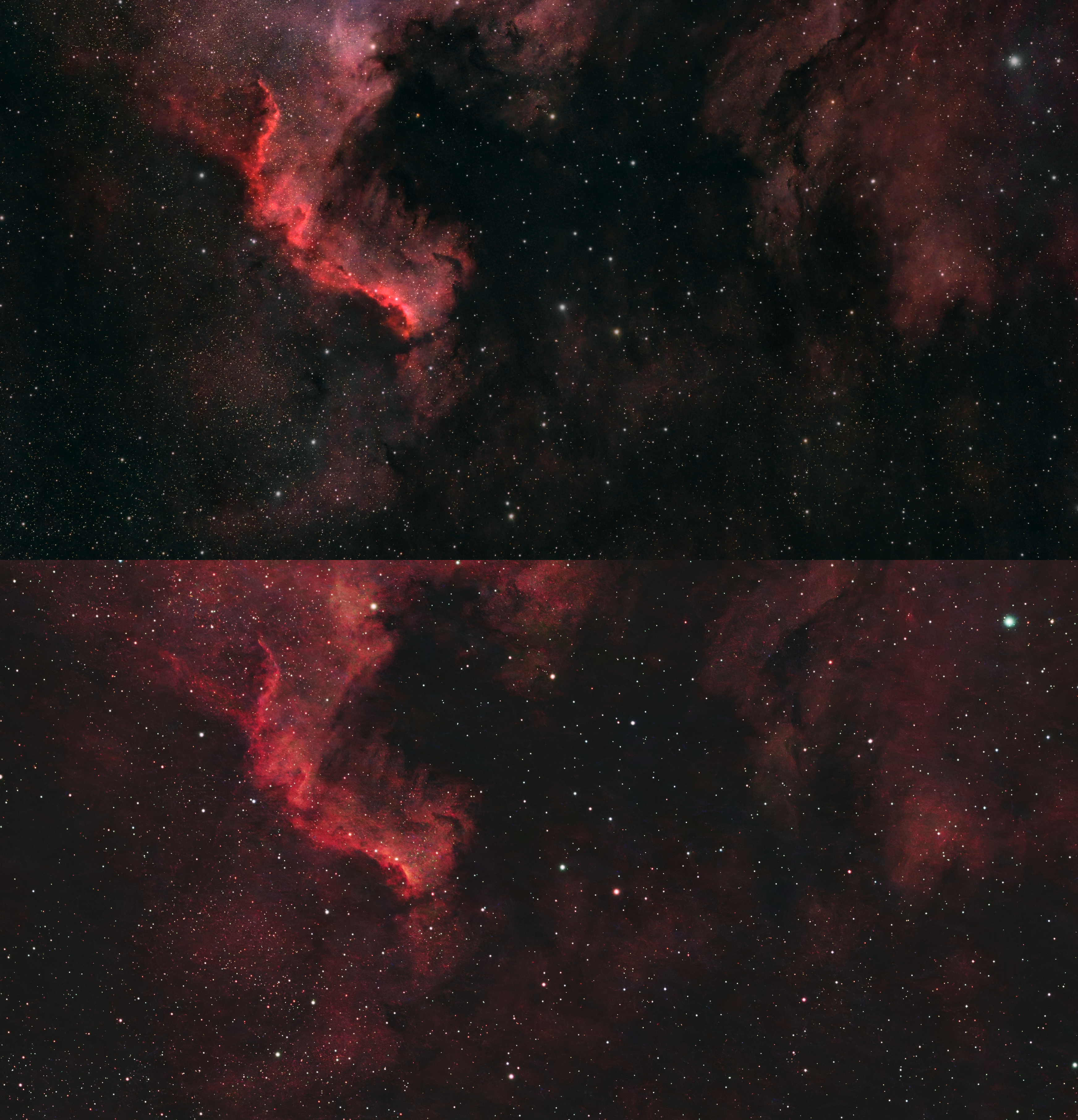
NGC7000 Canon vs. DWARF3
Side-by-side comparision of DWARF3 and a Canon rig.
Back to galleryOverall Assessment
Note: Both images were stacked and processed using the same PixInsight workflow. Therefore, the comparison primarily reflects differences in the optical systems and the raw data quality rather than differences in image processing.
At first glance, both images are remarkably close in quality—especially considering they were captured with two very different imaging systems (Canon 70–300mm L at 300 mm vs. DWARF 3).
| Criterion | Top (Canon 70–300mm L @ 300 mm) | Bottom (DWARF 3) |
|---|---|---|
| Star Sharpness | ⭐⭐⭐⭐⭐ | ⭐⭐⭐⭐☆ |
| Nebula Detail Resolution | ⭐⭐⭐⭐☆ | ⭐⭐⭐⭐☆ |
| Microcontrast | ⭐⭐⭐⭐⭐ | ⭐⭐⭐⭐☆ |
| Background Smoothness | ⭐⭐⭐⭐⭐ | ⭐⭐⭐⭐☆ |
| Color Fidelity | Slightly more neutral | Very similar |
| Overall Impression | Slightly superior optical performance | Impressive performance for a compact smart telescope |
1. Star Rendering
This is where the most noticeable difference appears.
Canon (Top)
- Stars are slightly smaller and more tightly focused.
- Bright stars exhibit cleaner point spread functions.
- Less apparent star bloating.
- Overall, the image appears slightly crisper.
DWARF 3 (Bottom)
- Stars are marginally larger.
- Mid-brightness stars appear just a little softer.
- The difference is subtle but consistently visible across the field.
Since both datasets were processed identically, BXT was applied, these differences most likely reflect the optical performance and native point spread function (PSF) of the two systems rather than processing.
Advantage: Canon
2. Nebula Detail
This is where the DWARF 3 performs exceptionally well.
The intricate filaments around the “Gulf of Mexico” region are preserved remarkably well.
Small-scale structures:
- are separated slightly more clearly in the Canon image,
- while appearing just a touch smoother in the DWARF 3 image.
Overall, I would estimate that the Canon provides approximately 5–10% higher microcontrast, but both systems resolve nearly the same large- and medium-scale nebular structures.
3. Dark Dust Lanes
The central dust structures show only subtle differences.
Canon
- Slightly stronger local contrast.
- Better tonal separation within the dark lanes.
DWARF 3
- Very similar overall structure.
- Slightly smoother transitions between dark and bright regions.
Because both images share the same PixInsight workflow, these differences likely originate from the optics, sampling, or signal-to-noise ratio rather than post-processing.
4. Background
The Canon image exhibits a slightly smoother background.
The DWARF 3 image, however, shows faint horizontal band-like structures within the weakest background emission.
Since both datasets underwent similar calibration, stacking, and processing in PixInsight, these artifacts are most likely inherent to the original data rather than introduced during post-processing.
Possible causes include:
- residual fixed-pattern noise,
- weak sensor banding,
- or limited dithering during acquisition.
These features are subtle but visible in the faintest regions of the image.
5. Overall Sharpness
The Canon image appears marginally crisper.
This is most likely due to:
- slightly better optical resolution,
- smaller stellar profiles,
- higher local contrast.
It is not because it resolves dramatically more nebular detail.
6. Resolution
Perhaps the most interesting result is that both systems resolve nearly the same amount of nebular structure.
The DWARF 3 captures an impressive amount of fine detail.
My subjective estimate would be:
- Canon: 100%
- DWARF 3: 90–95%
Considering the substantial difference in system size and complexity, this is an excellent result for the DWARF 3.
7. Color Rendering
Both datasets exhibit very similar color balance, reflecting the common PixInsight processing workflow.
The Canon image appears only slightly more neutral, while the differences are small enough that they may simply reflect variations in the original data rather than any meaningful difference in processing.
Final Verdict
- The Canon EF 70–300mm L delivers a modest but consistent advantage in star quality, microcontrast, and overall optical refinement.
- The DWARF 3, however, resolves nearly the same nebular detail and achieves approximately 90–95% of the perceived resolution while using a dramatically smaller and simpler imaging system.
The most significant difference lies in stellar point spread function (PSF) rather than nebular resolution. The Canon’s premium optics produce slightly tighter stars and higher local contrast, whereas the DWARF 3 demonstrates an impressively high level of detail for a compact smart telescope.