Examples
Frames from real nights, analyzed: what StarAberrationDiagnostics measured, how the result came about and how to see it in the maps themselves. How the calculations work is explained in the handbook; what each setting does, in the dialog reference.
The examples
- Newtonian f/5 with coma corrector: Sh2-142 - a series analysis of ten frames before and after the meridian flip. The coma-free point sits steadily at the lower right, outside the frame: the Newtonian is decollimated, and the corrector probably sits too close to the sensor.
Newtonian f/5 with coma corrector: Sh2-142
A series analysis from an ordinary imaging night: ten light frames of Sh2-142, five before and five after the meridian flip. The result in one sentence: the Newtonian is decollimated - the coma-free point lies at the lower right, just outside the frame, and in the same place on both sides of the flip - and the coma corrector probably sits a little too close to the sensor. This page shows how the script arrives at this result, how to see it in the four maps of the series yourself, and where the AI review needs to be complemented.
Handbook: 4. Describing the shape of a star, 5. Tracking and guiding errors, 7. Focus, sensor tilt and field curvature, 8. Radial and tangential patterns: corrector spacing, 9. Coma and collimation, 11. Series: before and after the meridian flip
The frames
| Object | Sh2-142 (Cepheus), night of 4 to 5 October 2026, captured with N.I.N.A. |
|---|---|
| Optics | Reflector 750 mm, f/5, with coma corrector - in the script: Reflector with coma corrector / reducer |
| Camera | ATR2600C (color sensor, APS-C, 6224 × 4168 pixels of 3.76 µm, i.e. 1.03″ per pixel), −10 °C, gain 100 |
| Frames | 10 of about 55 lights of 300 s, spread over the night: 5 on the west side (21:03-22:54), 5 on the east side (23:24-01:52, local time); the side comes from the FITS keyword PIERSIDE |
| Focus | 5246 steps all night, not refocused; the temperature fell from 21.5 to 18.7 °C |
The frames were used as they were: not calibrated, not registered, not cropped. The tracking was subtracted before the shape analysis (Subtract tracking); the AI review received the measured values without the maps.
How the result came about
- Pass 1 - each frame on its own. Each frame is measured as with Calculate: about 3000 stars per frame with PSF fit, asymmetry (third moment) and coma field fit. Each frame gives one row of the table below.
- Comparing the sides. For each value the script compares the median of the west side with that of the east side, measured against the scatter within each side, and judges stable, changes or unclear.
- Pass 2 - the static optics. The stars of all ten frames are pooled, about 30 000 stars. Before that, each frame loses its own changing tracking, and its FWHM is scaled to the median center FWHM, so that the seeing drops out. What remains is what is fixed to the sensor: the optics. This gives the four maps SeriesStatic_all_… shown on this page.
- AI review. The measured values of all frames and the comparison go to Claude (claude-opus-5-5) as JSON, with the request for a second opinion in the order of the corrections.
The measured values per frame
| Frame | Time | Side | Altitude | °C | FWHM center | FWHM edge | Tracking ε | Coma k | P0 (x; y) |
|---|---|---|---|---|---|---|---|---|---|
| 0000 | 21:03 | West | 71° | 21.5 | 4.19 | 5.59 | 0.26 | 1.40 | 0.59; 0.14 |
| 0003 | 21:19 | West | 73° | 21.4 | 4.28 | 5.71 | 0.51 | 1.14 | −0.14; 0.35 |
| 0008 | 21:46 | West | 76° | 20.9 | 3.03 | 4.40 | 0.20 | 2.54 | 0.52; 1.02 |
| 0011 | 22:02 | West | 78° | 20.7 | 2.77 | 4.26 | 0.29 | 3.27 | 0.52; 0.86 |
| 0021 | 22:54 | West | 83° | 20.0 | 3.35 | 4.73 | 0.31 | 2.29 | 0.48; 0.69 |
| 0026 | 23:24 | East | 83° | 19.6 | 3.35 | 4.68 | 0.41 | 2.49 | 0.86; 1.17 |
| 0031 | 23:51 | East | 81° | 19.4 | 2.85 | 4.08 | 0.13 | 3.52 | 0.52; 0.77 |
| 0039 | 00:33 | East | 76° | 19.1 | 3.33 | 4.74 | 0.21 | 2.19 | 0.54; 0.82 |
| 0043 | 00:54 | East | 74° | 19.1 | 2.95 | 4.37 | 0.09 | 3.07 | 0.60; 0.74 |
| 0054 | 01:52 | East | 66° | 18.7 | 3.92 | 5.14 | 0.32 | 1.47 | 0.49; 0.64 |
FWHM in pixels. P0 is the coma-free point, as an offset from the image center in units of the half diagonal R (x to the right, y downward); the image corner lies at 1, the bottom edge at y = 0.56.
Three things stand out in the table already:
- P0 lies in the same place in nine of ten frames, at about x = 0.5 and y = 0.7 to 0.8: lower right, just below the bottom edge. The exception is frame 0003 - the frame with the strongest tracking elongation (0.51). Uneven tracking adds the same asymmetry to all stars and shifts P0; this is exactly what the script warns about.
- k is always positive, but varies between 1.1 and 3.5 - with the seeing: the sharpest frames (0011, 0031: FWHM below 2.9 px) have the largest k, the softest (0000, 0003, 0054) the smallest. Blurred stars smear the flares. The position of P0 hardly depends on it, only the strength.
- The tracking changes from frame to frame in strength (0.09 to 0.51) and direction - a sign of guiding or wind, not of the optics.
The comparison of the sides
| Value | West (median) | East (median) | Verdict |
|---|---|---|---|
| FWHM center | 3.35 px | 3.33 px | stable |
| FWHM edge | 4.73 px | 4.68 px | stable |
| Corners / center (grid) | 1.35 | 1.30 | stable |
| Coma k | 2.29 | 2.49 | stable |
| Coma-free point | 0.52; 0.69 | 0.54; 0.77 | stable |
| Tilt | direction changes | unclear | |
| Edge elongation eps_rad | +0.26 | +0.32 | unclear |
| Tracking elongation | 0.29 | 0.21 | unclear |
The flip changes nothing measurable in the optics: no mirror flop, no play in the focuser. That is good news - and at the same time the bad news: the far off-center coma-free point is stable, that is, fixed in the optics. This is exactly what a decollimation looks like that collimating can fix.
Map 1: Coma
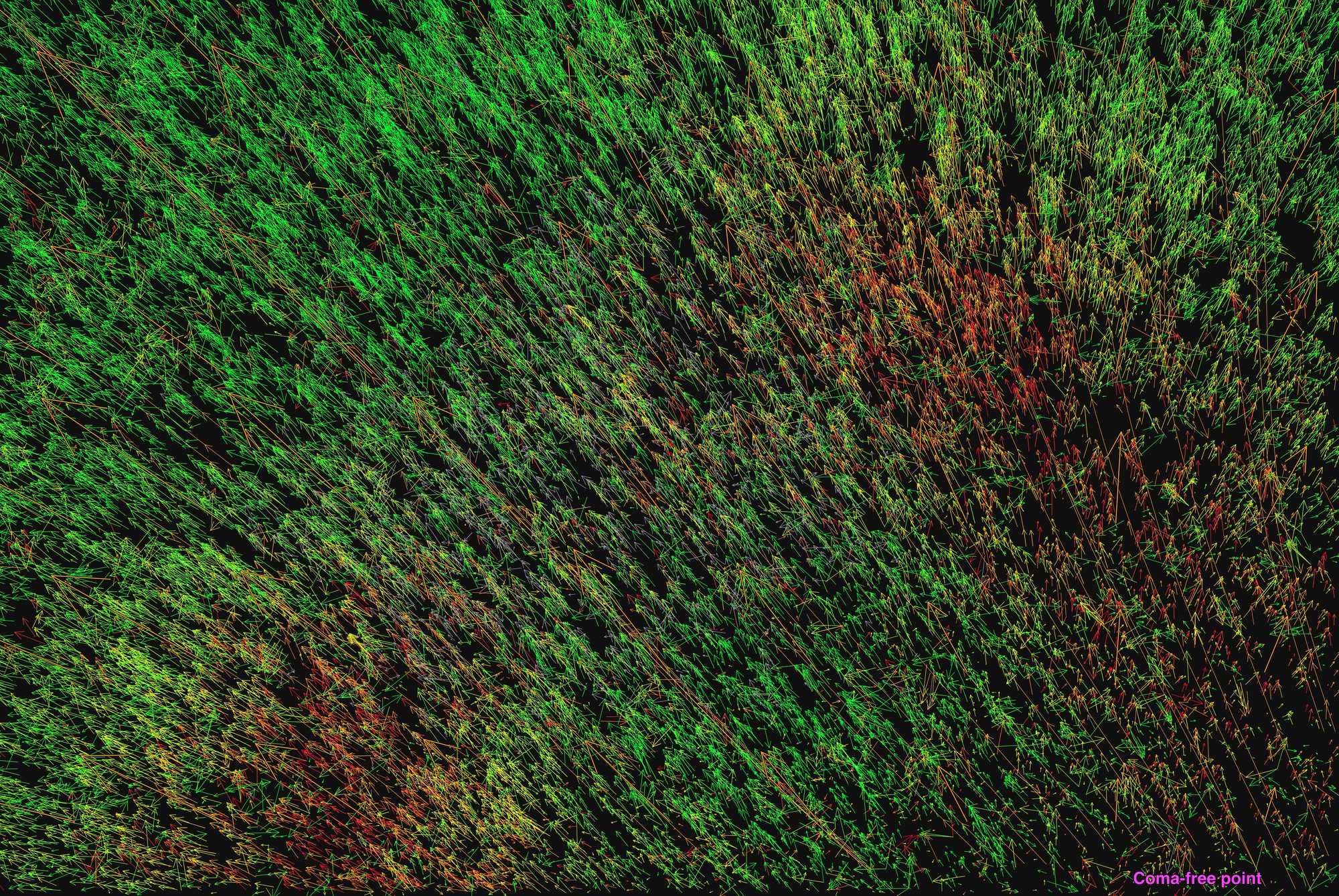
What you see: almost all arrows point to the upper left, across the whole frame. The orange streamlines run as parallel diagonals from the lower right to the upper left; the label Coma-free point stands at the bottom edge on the right, because the point itself lies just below the frame (at about x = 5100, y = 4700 to 5000 pixels).
What it means: under-corrected coma (k > 0) makes the flares point away from the coma-free point. If P0 were in the image center, the arrows would point outward like a star - to the upper left in the upper left corner, to the lower right in the lower right corner. Here they point the same way everywhere, because the "source" of the pattern lies outside the frame at the lower right: the frame is only a section to one side of it. The optical axis therefore does not meet the sensor in the center, but about 0.9 R beside it.
Map 2: Star shape
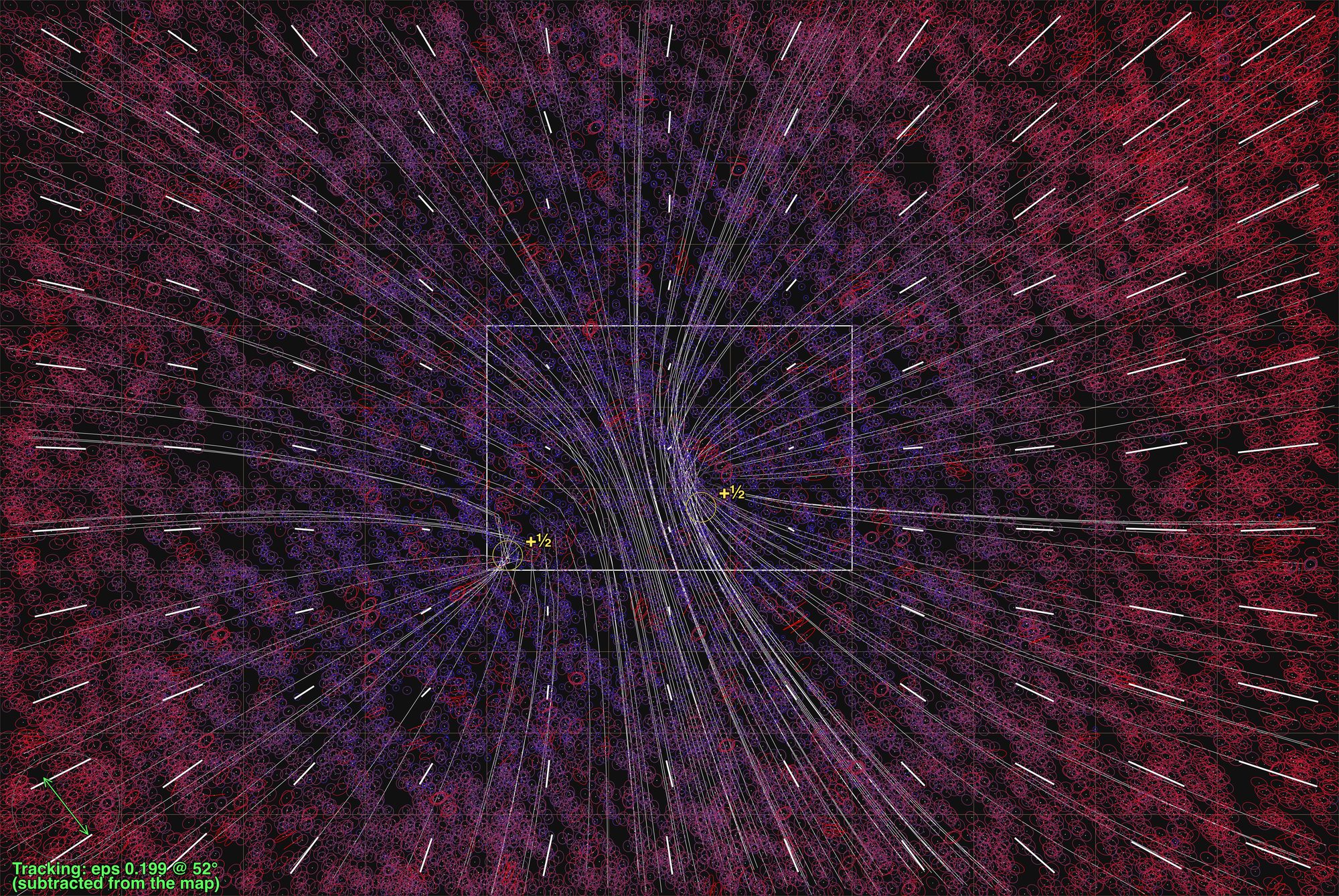
What you see: the streamlines run radially outward from the image center, and the white bars grow longer toward the edge; inside, the ellipses are blue and round, at the edge red and radially elongated (eps_rad +0.26 to +0.32).
What it means: radially elongated edge stars in a system with a corrector are the sign of under-correction - usually the corrector sits too close to the sensor (handbook, corrector spacing). This matches the sign of k.
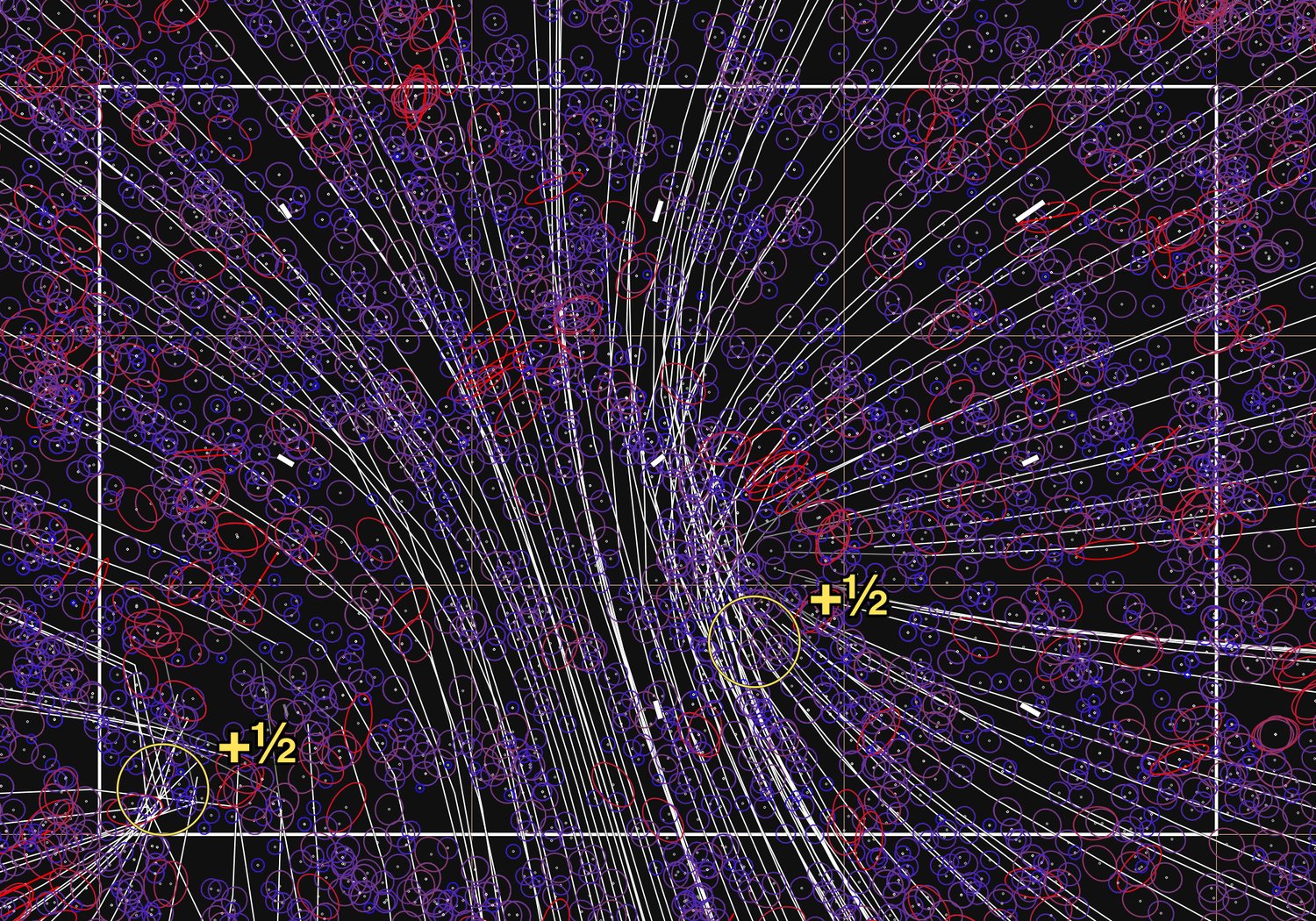
An important detail: the center of the radial pattern lies near the image center - between the two +½ points, about 400 pixels below and 300 pixels left of the center - not at the coma-free point at the lower right. Two +½ instead of one +1 appear when a uniform term splits the radial pattern; here that is the constant tracking (ε 0.20), which stays in the static map. The radial pattern and the coma asymmetry thus have different centers. This suggests two separate errors: a decollimated axis (map 1) and an error symmetric about the image center, such as the corrector spacing (map 2).
Map 3: Star size
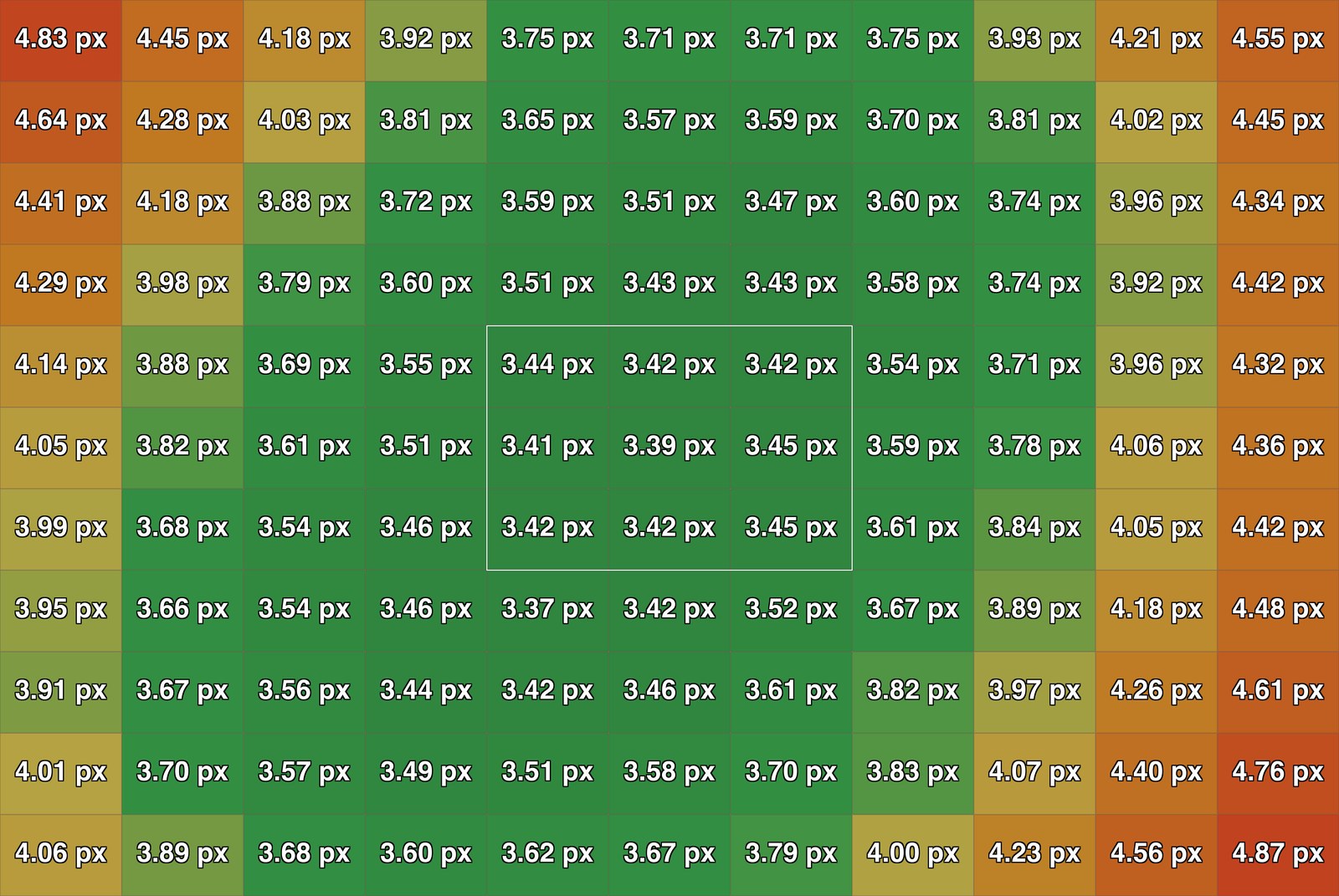
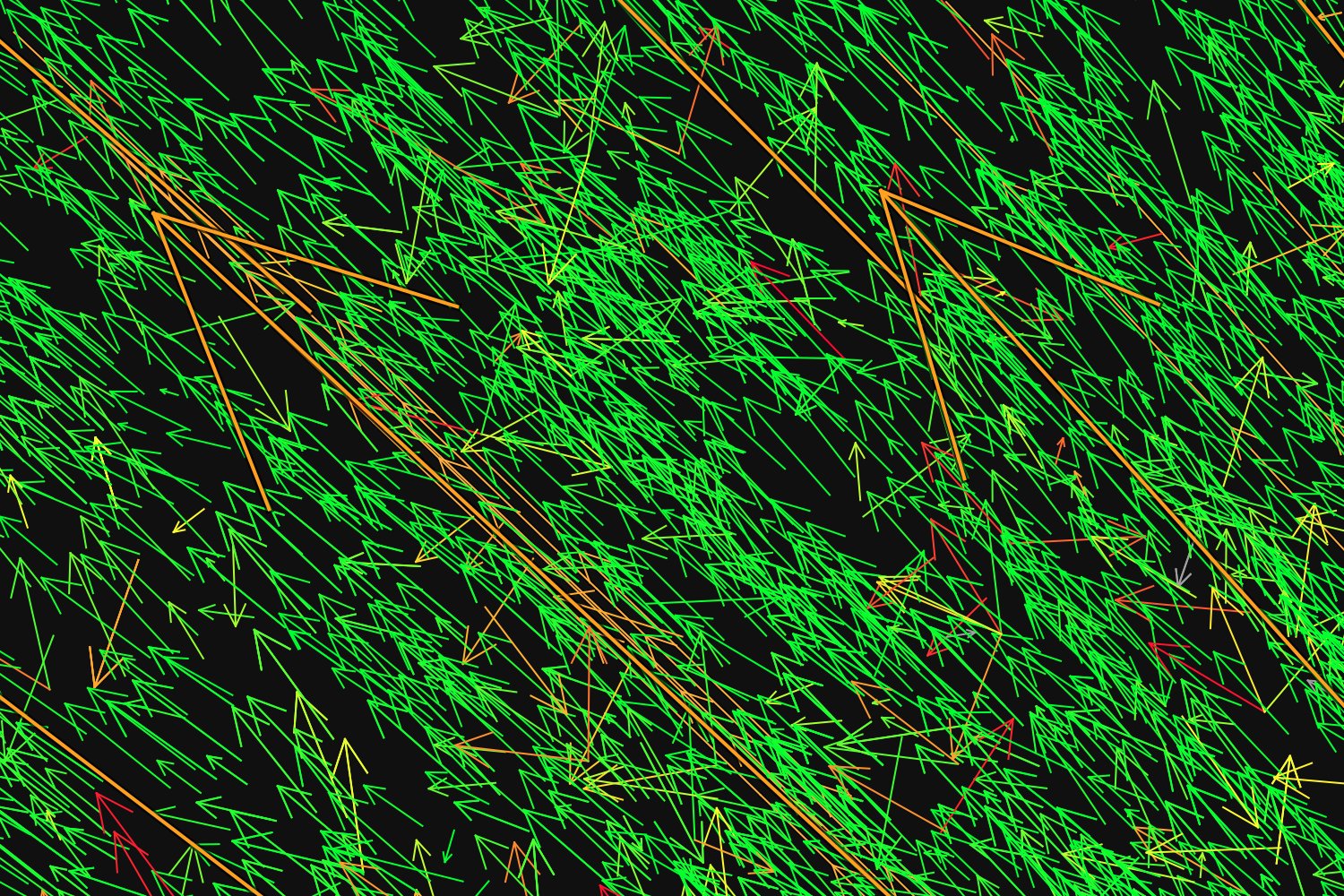
What you see: the center has 3.4 px (3.5″); toward the edge the stars grow in a ring. The corners: upper left 4.83 px (×1.41), upper right 4.55 (×1.33), lower left 4.06 (×1.19), lower right 4.87 (×1.42).
What it means: a ring around the center is the pattern of field curvature or corrector spacing, not of tilt - matching map 2. The lower left corner stands out, clearly sharper than the other three; a remainder of one-sided blur, such as a decollimation produces through the tilted image plane (map 4).
And the lower right? The corner near P0 has the most symmetric stars (hardly any coma, map 1), but at the same time the largest (×1.42). Symmetric does not mean sharp: there the radial error of map 2 bloats the stars.
Map 4: Tilt
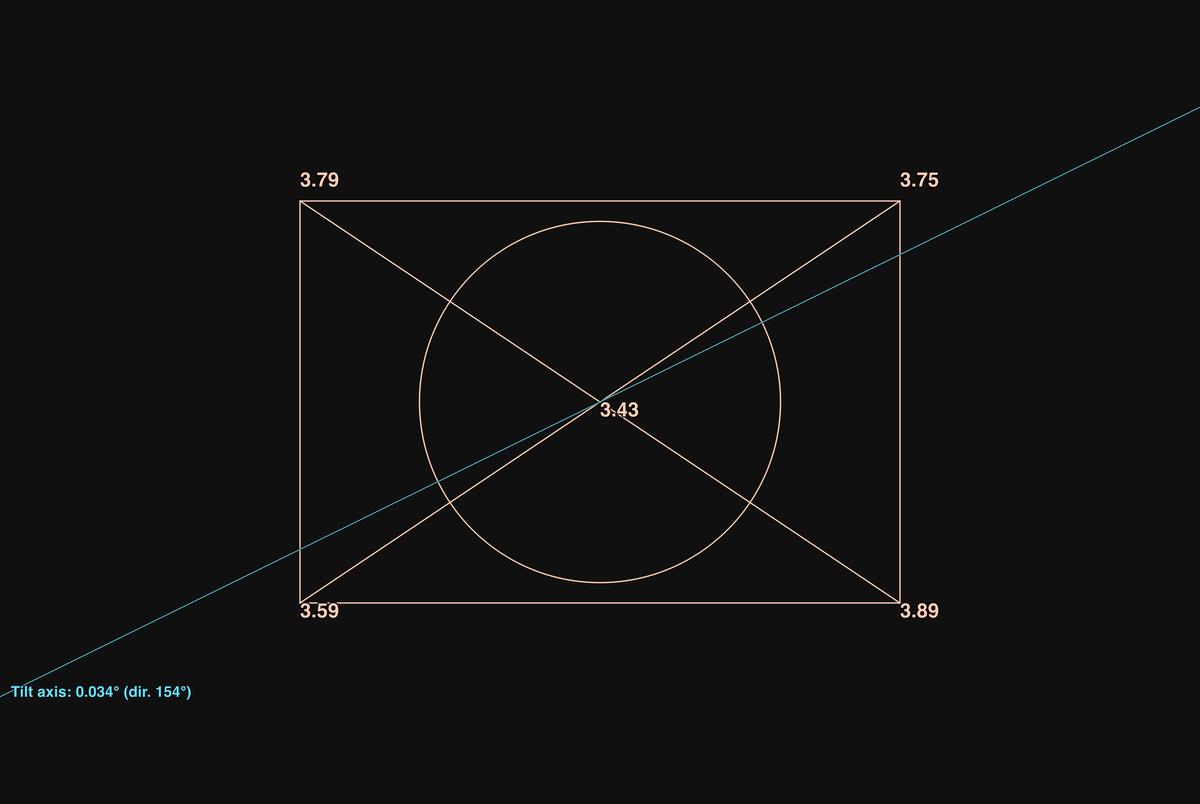
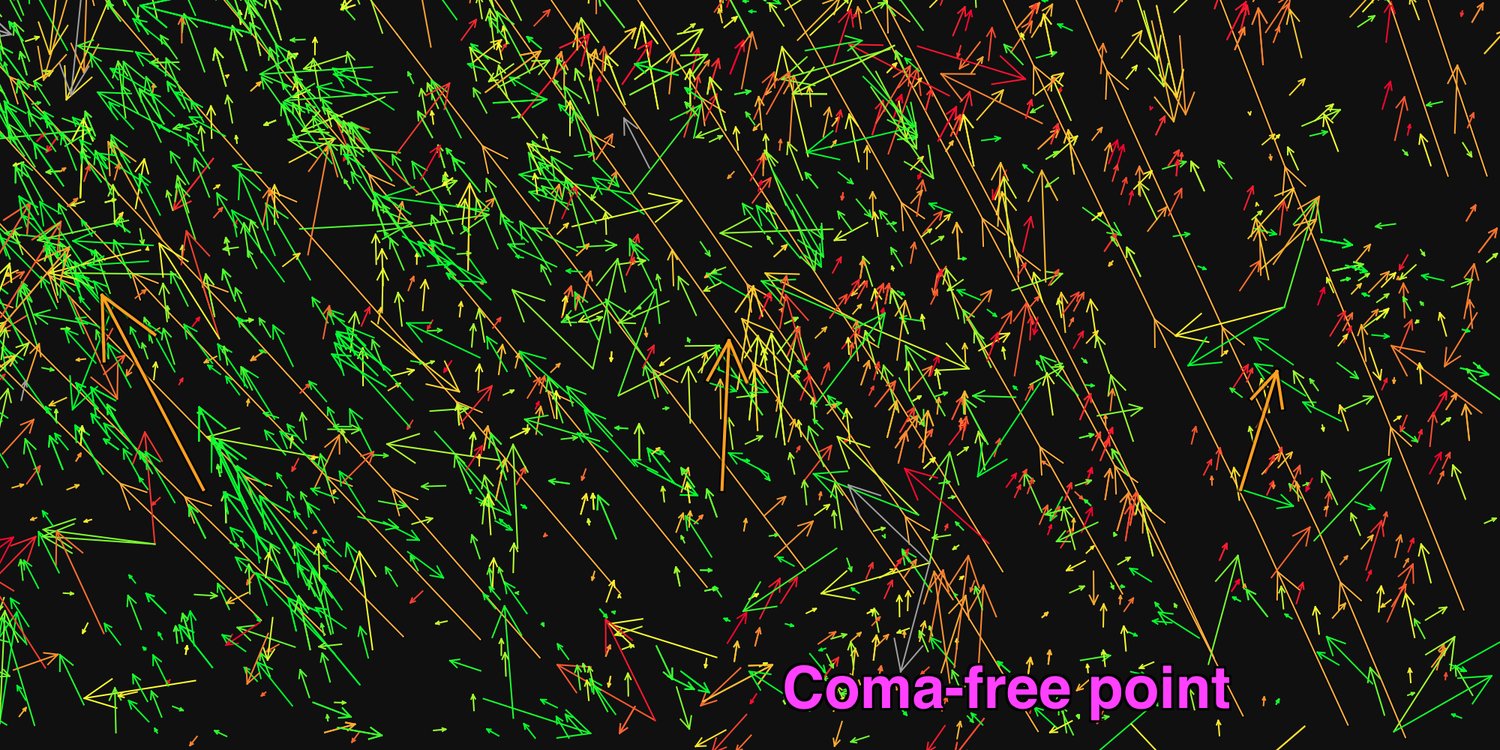
What you see: the quadrants lie between 3.59 px (lower left) and 3.89 px (lower right), the center at 3.43 px; the tilt axis gives only 0.034°.
What it means: in the single frames the script reports a one-sided blur of 14 to 32 %, but in changing directions - on the east side it jumps between 0° and 41° and 324° to 336°. Pooled, these directions largely cancel. A real sensor tilt would be fixed to the sensor and remain in pass 2; what remains here is small. The tilt of the single frames is therefore mostly seeing and tracking, no reason to turn the tilt adapter.
The AI review
Claude received the measured values of all ten frames and the comparison of the sides, but no maps; the statements on the "appearance of the stars" are therefore inferred from the numbers. Settings: Step by step (for beginners), language German. The answer, translated from the German original:
Verdict: The main problem is fixed in the optical setup: the coma-free point lies far at the lower right in all 10 frames. This points to a decollimation, probably together with too short a distance between coma corrector and sensor. The meridian flip itself is unremarkable: FWHM, corner ratio, coma and coma-free point stay the same on both sides, so there is no sign of mirror flop or play in the focuser.
Order: 1. Collimation, 2. coma corrector-sensor distance, 3. tilt, 4. focus over the night, 5. tracking/guiding.
[correct] Collimation - confidence: high
10 of 10 frames, stable across the flip
Observation: The median coma-free point lies at x=+0.52 and y=+0.69 to +0.77 rMax, about 0.9 rMax from the center. On the east side it scatters by only 0.07. The coma strength k is always positive, at 1.1 to 3.5.
Appearance of the stars: At the lower right the stars are most symmetric. Toward the opposite corner at the upper left they draw increasingly comet-like tails.
Reasoning: In a well-collimated reflector the coma-free point lies near the image center. It stays in the same place across the flip, so gravity does not cause it, but a fixed misalignment of the primary or secondary mirror to the axis.
Other causes: A tilted corrector or focuser would be possible. Nothing speaks directly against it, but decollimation is by far the more common cause in a Newtonian.
Action: Collimate with a laser or Cheshire, ideally followed by a star test with the camera mounted. Then adjust the primary mirror in small steps (about an eighth of a turn) so that the coma-free point moves to the center.
Check in the next test frame: The coma-free point should lie within about 0.2 rMax of the center. The four corners should look alike in FWHM and shape.
[correct] Coma corrector-sensor distance - confidence: medium
clear sign, but overlaid by the decollimation
Observation: k is positive in all frames, so the tails point outward. The edge stars are radially elongated (epsRad +0.14 to +0.35), and the corners are about 1.3 times as large as the center.
Appearance of the stars: At the edge the stars are drawn outward, like small comets pointing away from the image center.
Reasoning: Tails pointing outward together with radial elongation mean under-corrected coma. This typically happens when the corrector sits too close to the sensor.
Other causes: The decollimation distorts the pattern and can fake part of k. So reassess after collimating.
Action: After collimating, increase the distance between corrector and sensor in steps of 0.5 to 1 mm, with spacer rings. Check the manufacturer's nominal distance first.
Check in the next test frame: k should go toward 0, epsRad at the edge fall below about 0.1 and the corner ratio drop toward 1.1. If k changes its sign, the step was too large.
[note] Tilt - confidence: low
direction scatters, cause unclear
Observation: The one-sided blur lies at 14 to 32 %. On the west side it points steadily to the upper right (286 to 325°), on the east side it jumps back and forth between 0 and 41° and 324 to 336°.
Reasoning: A decollimation also produces one-sided blur. A real sensor tilt would show a fixed direction on both sides, which is not the case on the east side.
Other causes: A sensor tilt at the camera adapter is possible, if the direction stays stable after collimating.
Action: Do not adjust anything for now, and measure again after collimation and spacing correction.
Check in the next test frame: If more than 10 % blur remains in a fixed direction, check the adapter or tilt adapter.
[note] Focus over the night - confidence: medium
focus unchanged, temperature fell
Observation: The focus position stayed at 5246 all night, while the temperature fell by 2.9 °C. The FWHM in the center varies between 2.8 and 4.3 px and was largest in the first two frames (4.2 and 4.3) and in the last (3.9).
Reasoning: With a pure focus drift the stars would grow steadily over time, which is not the case here. The large values at the start and at the end fit better with a mirror not yet cooled down and with the lower altitude (66 to 73°).
Other causes: Seeing alone is possible, but cannot be separated from a single series.
Action: Let the telescope cool down for at least 1 hour before starting. Also refocus every 1 °C or so of temperature drop, or hourly.
Check in the next test frame: The FWHM in the center should stay more even over the night, below about 3.2 px.
[note] Tracking/guiding - confidence: medium
strongly varying, no flip effect
Observation: The elongation shared by all stars varies between 0.09 and 0.51, its direction between 13 and 95°. It was subtracted before the shape analysis.
Appearance of the stars: In single frames, above all frame 0003, all stars are oval in the same direction.
Reasoning: If the direction changes from frame to frame, the tracking quality is the cause, not the optics. A fixed optical cause such as astigmatism would always look the same instead.
Other causes: Wind or cable drag are possible. Nothing in the data speaks against them, but they cannot be checked either.
Action: Check the guiding log (RMS) and the balance, and relieve the cables.
Check in the next test frame: The shared elongation should stay below about 0.15 in all frames.
Disagreements with the script's assessment
The script calls tilt, epsRad and tracking unclear at the flip. But the differences lie within the scatter from frame to frame and have nothing to do with the flip. More important is what the script judges stable: precisely the stable, far off-center coma-free point is the main finding and no all-clear.
What the maps add to the AI review
The maps confirm the order and the main finding of the AI: collimate first, then the corrector spacing, leave the tilt alone for now. In four places the maps tell more than the numbers alone:
- "At the lower right the stars are most symmetric" is true for the coma (map 1), but there the stars are also the largest (map 3, ×1.42). When comparing the corners after collimating, do not read this as a new error.
- Two errors, not one faking the other: the AI considers it possible that the decollimation fakes part of k. But map 2 shows a radial pattern about the image center, not about P0. The corrector spacing is therefore a finding of its own - the order stays right all the same, because after collimating both patterns can be measured without overlapping.
- The tilt almost vanishes in pass 2 (0.034°). This supports the AI's verdict ("do not adjust anything for now") more clearly than the single frames can.
- Frame 0003 is the example of the script's warning: with the strongest tracking elongation of the series, its P0 is the only one in another place. A single frame with poor tracking would have led to a wrong collimation direction - hence the series.
Next steps
- Collimate the secondary and primary mirror (laser or Cheshire), then fine-tune on the stars: P0 lies at the lower right; adjust the primary mirror screws in small steps so that it moves to the center, and take and measure a frame after each step.
- When P0 lies within about 0.15-0.2 R of the center: a new short series. If eps_rad at the edge is still clearly positive and k > 0, increase the corrector-sensor distance in steps of 0.5 mm.
- Only then assess the tilt - and only if it remains in pass 2 with a fixed direction.